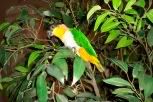
Not too long ago we heard of a black headed caique chick involved in an attempted robbery at Omars Exotic Bird Store. Its happened again, this time in Long Island.
Cops: Man steals pricey parrot in West Islip
BY MATTHEW CHAYES |matthew.chayes@newsday.com9:06 PM EST, January 27, 2009 Surveillance video shows a brazen parrot thief hiding a $1,399 baby black-headed caique bird in his jacket, then walking out of the West Islip pet store that was selling the bird without paying.
Suffolk County police detectives are scrutinizing the footage to try to identify the man videotaped in the avian apprehension from BTJ's Jungle pet store on Sunrise Highway, a department spokesman said.
The three brothers who own BTJ's Jungle couldn't at first figure out where one of their caiques had gone, but realized they'd been victims once they reviewed hours and hours of surveillance video, co-owner Tom Niehoff said Tuesday, the day that the theft was reported to police.
"It's a pricey bird," Niehoff said. "The bird that he happened to pick is a very quiet bird. They don't make a lot of noise."
The theft occurred on Jan. 19 when two men walked into the store, police said. Immediately upon entering, one man made a beeline for the tank holding the bird and placed it in his jacket. Then with an accomplice, he bought crickets.
The theft of the caique is at least the second time on Long Island in less than two months that animals have been taken out of a store undetected.
In December, a man hid a foot-long baby nurse shark in his jacket; Nassau police arrested that suspect, Elbert Starks, 30, of Freeport, a month later.
"People are stealing left and right there," Niehoff said as a menagerie chirped in the background.
There is a video too that can be seen here
Caique Stolen From Petstore
Papegaaien Journal
A Dutch Magazine called Papageaaien Journal, or, ParrotJournal recently published an article written by site owner Emily. Here is an excerpt (in English) of the original version.
"Full of personality
Caiques have become infamous for their clown-like personalities. They have quickly gained the well-deserved reputation of being the clowns of the avian world. Whether they are attempting to moonwalk (hanging upside down in the cage and walking across the top), hopping like a kangaroo, or sleeping on their backs, caiques are always good for a laugh. I am often asked to describe the personality of the caique. It can be hard to perfectly characterize these bundles of joy. I usually use the following description:
"Imagine a dog, like a border collie, the type of dog that needs to be worked (for its sanity and the owners!). Now, mix in the intelligence of an African Grey parrot, and the attention span of a moth. That is a caique."
True to form, caiques are little busybodies."
To view the article in dutch, you can follow this link -
http://www.papegaaienjournaal.nl/papegaaien%20journaal%20dec08.pdf
The article will also soon be available for download on the caiquecrazy.org website.
The debate begins
We had a friendly mock debate on the forum which had me in stitches laughing, so I thought I would share with you all. People divided up and tried to convince the other 'team' which caique species was the superior.
Posted by user Kokomo:
Let me shed a little light on this subject.
Back in 'Ye Olden Days' there was thought to be only one type of Caique and it was what we refer to today as 'The Black Headed Caique'. We all know how awesome of a companion bird the BHC is so it should come as no surprise that any/every person of stature would obtain a BHC to as a status symbol. Being the BHCs were more than the folks bargained for the BHC quickly turned in to quite a bit more than status symbols. They won over the hearts of their human owners and became members of their family. Some BHCs were even regarded as royalty and owned/ruled over townships and cities. Now this was indeed a time of turmoil and imperfection. Big changes were afoot and not everyone was in agreement with the changes that were brewing. ***PAY ATTENTION HERE as it gets really complicated.*** A strange man from a small country just south of where one of the most powerful BHCs ruled came to town. (We will refer to this man as Mr. J. because history has many different versions of this story and we won't complicate it with any of the names associated with them.) Mr. J. was a wise man and shared a wealth of knowledge with any and all people that would ask for his words. The ruling BHCs assembled a group of men to speak with Mr. J. The BHCs wanted to remain anonymous as they suspected Mr. J. knew a secret that would be thier undoing. Under instruction of the ruling BHCs these twelve men learned a lot from Mr. J. and one night at the dinner table one of the men asked Mr. J. if the beloved BHC was the best bird in all of the world. Mr. J. responded to this question with a pause and then answered -(and I quote) "No. There is another. One that is extremely close to the BHC but has a head that resembles the Sun." RESEMBLES THE SUN PEOPLE. The men were taken back by this info. They didn't know what to do. Should they go to their ruling BHCs and tell them of this news? Surely the ruling BHCs would want to banish and destroy all knowledge of this Sun Headed Caique. The men even feared that they would be either killed or have thier tongues removed to keep this secret safe from the people. The men continued to ask Mr. J. questions about the [i]Sun Headed Caique[/i] and had a local artist paint a picture of the bird. They asked Mr. J. if it would be appropriate to officially name the Sun Headed Caique the White Bellied Caique. Mr. J. said to the men (and I quote) "That would be a very accurate description but it wouldn't differentiate the Sun Headed Caique from the BHC." The men agreed with Mr. J. but told Mr. J. that the BHC's name would differentiate it from the Sun Headed Caique and not make it seem like the Sun Headed Caique was trying to be like the BHC by having the word 'Head' in its name. Mr. J. gave some thought to his and said (and I quote) "Cool." This is really a long story and many books have been written about it so if you want all the details just look into getting one of the books. I will tell you that when the BHCs got word of the teachings of Mr. J. they captured him and two of the twelve men that they had hired and had them CRUCIFIED!!!!! They wanted to set an example of what would happen if they caught anyone talking of a WBC or how it is the best bird in all the land.
I have included pictures of Mr. J. and the twelve men. This is just after Mr. J. told them of the 'Sun Headed Caique'. They are discussing the official naming of what is now the WBC._-_The_Last_Supper_(1495-1498).jpg)
Merry Christmas!
This post is a little late, but I wanted to wish everyone a happy holiday season. For this months post, I wanted to let you preview an excerpt of an article that will be appearing in the latest edition of the BirdBoard.com newsletter. Remember, decorating for the holidays can be fun, but you want to make sure your decorations are bird safe as well!
"During the holidays, there are many new and exciting things we use to decorate around the house that can be as dangerous to your avian friend as they are pretty. We want your holidays to be fun and safe, so we are addressing the common holiday household dangers for 2008.
Among the most common decorations for the winter season, is mistletoe. This often seen holiday plant that harbors such fairytale legend also has a dark side. Mistletoe is part of the Viscaceae family, and the form commonly seen in North America is a hybrid plant of both English and European varieties. Mistletoe is famous for bearing its fruit in the winter months, making it a popular decoration during the Christmas seasons. The red berries that are so trademark of mistletoe are toxic to our avian friends, as are holly berries. Another favorite holiday plant, the Poinsetta, can cause GI tract irritation if ingested. "
Catch the rest of this article soon, coming to an inbox near you!
Baby its cold outside!
With the winter weather upon us, its about the time of year that bird owners start to worry about their fidlets freezing their, um, tails off. Some winter suggestions for keeping your fids warm include:
-Investing in a heated perch. I've heard many good things about this product. Best for smaller birds like caiques that are not prone to trying to chew through heavy plastic items.
- Invest in a heavy, warm cage cover. In doing this you can turn the heat down a couple degrees at night, save on your heating bill, but not worry about turning your feathered friend into a birdie popsicle
- A reptile ceramic heat emitter (emits heat only, no light) works great as a heat source for your bird.
If you invest in one, be sure to put the emitter into the appropriate light source, such as this one that has a ceramic socket which will not pose a fire hazard. One with a dimmer switch like this works perfectly to give you control of heat output.
Avitec also sells avian heat panels which can install in an aviary or your home to provide your bird a warm place to cuddle up to. I've heard lots of good reviews about these devices as well.
Stay warm, and have a happy thanksgiving!
Long time, no blog!
After a short hiatus from the blogsphere, I am back!
I just wanted to take the time and give a shout out to all our site sponsors for caiquecrazy.org and caiqueforum.com
Birds Comfort - birdscomfort.com
HQ Bird Cages - hqbirdcages.com
FeatherBrite- Featherbrite.com
Feathered Friends Momentos- featheredfriendsmomentos.com
Arlissa Green Creations- arlissagreen.com
Davis Aviary- Davisaviary.com
We appreciate your support of our website! We take every opportunity to refer customers to you :)
More spots are opening on the site, so if your small business is interested in some thrifty advertising opportunity, please contact Emily at emily@caiquecrazy.org subject line: Advertising. We'd be more then happy to work something out with you! Spots on the website and forum are now available.
Wishing everyone a wonderful beginning of November!
Caique Stolen at Omars
News: Man tries to make off with $1,300 bird | customers, sklar, bird, birds, shop - OCRegister.com
Video: Man tries to make off with $1,300 bird
Surveillance video shows a man putting a black headed Caique inside his jacket, and the bird crawling out before being chased down by customers and employees.
By SALVADOR HERNANDEZ
The Orange County Register
Comments 28 | Recommend 6
LINK TO VIDEO EVIDENCE!
LAKE FOREST Even with clipped wings, the costly bird refused to go with its alleged birdnapper.
A 35-year-old man tried to stuff a $1,300 bird into his jacket from Omar's Exotic Birds and then ran out of the pet shop Sunday afternoon, but the brightly colored bird wiggled out of the jacket, alerting customers and employees of the theft.
Customers ran out and held down James Leland Loper until deputies arrived and took him into custody on suspicion of grand theft, said Lt. Fred Furey of the Orange County Sheriff's Department.
Surveillance video shows the man playing with the birds, which roam freely on perches or sit inside glass enclosures that are open at the top, said Danielle Sklar, assistant manager of the pet shop.
An employee approached Loper and asked him if he needed help, but he said he was just looking, Sklar said. For about 30 minutes he interacted with the birds in the store like the rest of the customers.
Then, after looking around for people around him, the suspect shuffled the black headed Caique inside his jacket and walked out.
"Somebody just saw a bird coming out of his shirt," Sklar said. "It didn't want to stay put."
A group of customers and employees ran after him as he hurried across El Toro Road. One of the customers tackled him and held him until deputies arrived.
Customers are allowed to interact with the birds inside the pet shop, but several visible cameras hang on the ceiling to deter any possible shoplifters, Sklar said. Thefts in the shop are rare, but surveillance video catches those that try to make off with the merchandise.
The store will perches and displays as they are, with customers having free access to the animals, Sklar said. This helps the customers find a bird whose personality meets their own.
The black headed Caique, a parrot with green wings, yellow neck and a black head which is native to South America, was recovered and is back in the store, waiting for an owner willing to pay for it. The price tag is $1,300.

 Posts
Posts