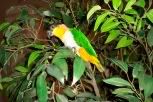
We are polling to see if the amount of yellow tipping on a caiques tailfeathers has any correlation with age and/or sex. Please vote now to help us gather our data!
Caique Poll
How much time does it really take?
You tend to hear that question alot. 'Well, birds can't be that much trouble. They are in cages, after all.' No such statement could be further from the truth. In fact, its been said that having one parrot in the house can be equated to living with a dolphin or chimp. And thats just one parrot! Most people have a multiple bird household. How does one bird really affect the household and how much time does it really take to care for that bird?
I've been conducting an informal experiment. I took my camera and started photographing everything I do on a daily basis for my birds. Clean cages, weigh the birds, feed the birds, cook for the birds. Well, you get the idea. It was mind boggling how much effort one actually puts into caring properly for these amazing creatures! A photo journaling of my 'day for the birds' is soon to follow.
March is fast approaching
and do you know what that means? March 23rd, 2008 will be our 2 year anniversary! We are going to celebrate big time, with lots of pomp and circumstance :) Keep your eyes peeled for new and exciting additions to the 'CC Empire!'
If you haven't already, please check out our forums. We recently switched servers, which unfortunately wiped out all members. Please take a moment and register again! This new forum is better and faster then ever. We want you with us as we celebrate our special two year anniversary!!!
Because I've been delinquent with keeping up with the blog lately, here are some interesting caique photos I took with my new Sony Cybershot Camera


The Hierarchy of Parrot Needs
This is a post I wrote about a year ago on a parrot message board, in regards to a posters question about parrots and dependency, the need for. This was my response:
OK here it is. Bare with me as this is all pure speculation/observation on my part and I am going to be jumping around alot, K?
Have you ever heard of Maslows Hiercharcy of Needs? The theory is that once your basic needs are fulfilled- shelter, food, security- you can move 'up the ladder' and continue to fillfull lesser needs- needs that you do not need for basic survival. Needs like self esteem, postive interaction with peers. The highest need is self fulfillment- self awareness. It is estimated that very few, if any, human beings ever fulfill this need because we are continually moving up and down the hierarchy.
True parrot flock dynamics are instinctual, and based on survival. Parrots need other parrots. They need them for security- they warn each other of predators. They need each other for socialization- verbal and physical, like grooming. They need a flock so they can pick a mate and continue the circle of life.
In a cage a parrot has everything given to him. Food in a bowl eliminates the 4-9 hours a day your bird would be foraging. Toys and huts replace time the bird would spend seeking shelter and things to play with. A clean water dish eliminates hours of flying to find a fresh water source.
So whats left? Socialization of course! Verbal- isn't it fun to scream?! And physical- preen me, I itch. And your bird has 15+ hours a day to long for it, because everything else has been handed to him.
Hence the need for independence. Hence the difference between true parrot flock dynamics and human flock dynamics. In the wild, a parrot is always with another bird- in a 'flock'. At home, your bird may be around you, your dog ,your cat, your goldfish- but never have those true parrot flock dynamics.
Now- back to our handy-dandy hierarchy of needs.
This diagram is based on a humans hierarchy of needs- and is a bit more complicated then needs be, IMO. But it illustrates what I am going to be talking about well.
[img]http://i18.tinypic.com/2egh0eq.png[/img]
OK so picture a parrot. In the wild your parrot has to work to fulfill his physiological needs each day. Thats an all day job. Once those needs are fulfilled, he/she needs to find a safe place to roost for the night, and/or a safe nesting cavity to raise babies. That fulfills safety needs. Your bird has now moved up 2 places on the pyramid.
The flock dynamic, and your birds mate would most likely fulfill the love/belonging need (I do not want to get into these aspects too much because otherwise its going to lead into a lot of guesswork/anthromorphization/illogical reasoning)
Your bird is almost to self fulfillment. In humans, sell fulfillment is the ULTIMATE. We want for nothing, have everything, have no issues. I hesitate to move a bird to the esteem rung, simply because can birds have an esteem need in the sense humans do? You decide.
Either way you look at it- your bird in the wild is pretty far up in the hierarchy just by fulfilling basic needs on a daily basis. Higher up then some humans will ever get, for that matter.
Now- take a captive bird.
Physiological needs- handed to them. Why the need to fulfill if they are already there? Food, check. Water, check. Sleep, check. Clean cage, check.
Safety needs- fulfilled. A cage in an area away from natural dangers.
This leaves us at the love/belonging need.
OK so this is where dependency and the hierarchy theory ties in, for me at least. You can't want what you never missed, or in this case didn't acknowledge you already had- in this case physiological and safety needs. So it makes logical sense, if you are looking at the hierarchy- that most parrots start out trying to fulfill the love/belonging need. Whether or not it is fulfilled is based on the interaction between human and parrot.
I think that, IMHO, once the love/belonging need is fulfilled, the bird can move up the hierarchy to what we would view as fulfillment- in this case not having to be Dependant upon a human for everything. IE playing in the cage while the human is away, participating in foraging and natural preening activities, engaging in regular sleeping patterns, etc.
To be stuck in the dependent stage, would to be stuck on trying to fulfill one of the hierarchy needs. In most birds cases, its the love/belonging. Where do i fit in, in this human flock? Are they going to take me out today?
Now- interesting concept here. Compare the behaviors of a wild bird with behaviors of a captive birds, and their place on the hierarchy. A captive bird, as I said, i believed would be on self atualization portion of the pyramid, having fulfilled all other needs on a daily basis. Wild birds do not pluck- they do not bite (biting is a captive bird behavior, wild birds do not bite other then to warn of danger- they do not inflict harm with their beaks with the intent to hurt) and they certainly do not have screaming issues! they play, they fly, they make nests and have chicks.
Consider the captive bird. The captive bird is, from my perspective, usually stuck on the love/belonging part of the hierarchy. It is not uncommon to hear of, or even live with a bird that has biting, screaming, plucking/self mutilating issues. A bird that is clipped, that does not have chicks, and participate in other natural activities.
So where does this leave us?
Seems to me the bird that has more freedom- ie socialization within flock dynamics, be it human or bird, is taught to forage, engage in natural activities such as bathing, preening, playing with toys- is one to be happier because they can have lives outside their human. Being independant is not a bad thing- its being dependent that can turn into damaging.
Changes
For everyone I traded links with: can you please email them to me again? I lost my link back list when I switched the format of the blog.
I've been working hard on redoing the blog and website to make it more user friendly. Easier navigation, easier to read, all around simplified. Everything is still in progress so bare with me! I am trying to get it all done as quickly as possible, because it frustrates me to leave projects half finished lying around.
Happy January everyone!
Bird of the Month

Caiques are bird of the month on www.birdchannel.com (hosted by the BirdTalk magazine folks). They are requesting people send in their stories of living with caiques, and why these birds are special to you. This is a great chance to educate others about these wonderful birds, so please, if you have a caique, consider sending a story in!
My submission:
I am owned by two rehomed caiques, Higgins and Rosie (aka Goober).
They are the loves of my life- after living with caiques for three
years I can't imagine having a house without these wonderful birds.
I'm often asked by non bird folk what caiques are like, and why I am
so attracted to them. In an effort to help people understand what a
caique is really like, I give this description: "Imagine a dog, like a
border collie, the type of dog that needs to be worked. Now, mix in
the intelligence of an african grey parrot, and the attention span of
a moth. You have a caique".
There is never a dull moment with a caique around. They may be hanging
from the curtains, flying from playgym to playgym with a great big
'whirrring' sound to wrestle with one another, or beating up toys in
their cages. They are fantastic eaters and eat with gusto. I often
refer to them as little garbage disposals- I've yet to find a food
they dislike!
Another thing that endears me to these wonderful little birds is how
outgoing they are. I've had neighborhood children come and play with
my birds, much to the birds delight. Just about anyone can handle
them, so long as they are unafraid. Most people are taken quickly by
their quirky little personalities.
Higgins and Rosie bring laughter into my life daily. I enjoy looking
into the future with them and growing old together.
Emily of Caique Crazy Forums
Caiques are unique
Caiques are an interesting species. They differ in many ways from other parrot species, both in large ways and small. As we learn more about caiques, and parrots in general, we gain greater knowledge on how to care for these birds in a more natural and healthful way.
Like other parrot species, caiques can hybridize. They can hybridize amoung themselves- there have been noted yellowthigh/black head hybrids, as well as green thigh/ yellow thigh. Interestingly, unlike some other parrot species, it has been noted that caiques can hybridize with other species of birds. On his website, John McMichael has a small blurb about a caique hybridizing with an illigers macaw. Unfortunately no pictures are available, and no information is provided as to if the eggs were fertile or not. This piece of information has the potential for a lot- if the eggs were fertile, it would mean that genetically caiques are 'close' to the family of small macaws. We could learn a lot by analyzing and probing for more information.
Did you know caique parrots are right footed? Studies have shown that a parrot can show 'footedness', that is, a preference of using one foot over the other when eating, etc. Much like our preference for writing with one hand or the other. In comparison to other parrot species generally exhibiting left foot preference, caiques prefer the right foot. I wonder what this means as to their way of thinking? In humans, using one hand over the other shows a 'brain side preference- left or right'.
Unlike other parrots, the caiques upper beak, the maxilla, is not fixed, but rather hinged. This is believed to be an adaption to climbing.
It is also said that caique chicks are deaf when they are hatched, unlike other parrot species. They are also born with no ear opening. The opening appears at around two to three weeks of age, when the eyes begin to open.
Interestingly, information and prints on caiques date back to 1783. Yet in 2007, this bird is considered to be somewhat rare in the avian community, not being as readily available as other parrot species in the pet trade.
One must wonder about the lack of information available on these parrots, and when they will gain enough attention from influential people within the avian community to warrant observation and study.
Subscribe to:
Posts (RSS)

 Posts