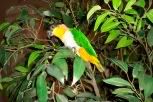
Poking around the internet one day on my never ending quest for further caique information, I found quite the interesting photo that I would like to share. This photo comes from the Bird A Day Blog
This is Magoo, a pallid caique. Magoo's owner says about him-
"Magoo is a pallid caique from the rainforests of Peru. He is the most hilarious clown, with a terrific personality and most loving curiosity. .. oh, and the healthiest appetite you can see!"
Photos Credit Cynthia: Lima, Peru
Pallid caiques are the only subspecies of the nominate black headed caique, scientific name Pionites Melanocephala. The Pallid is Pionites Melanocephala Pallidas.
Pallids are a rare site to see, as they are not kept in US aviculture in all, and very rarely in collections outside of the US. Only one other breeder has been recognized in the United Kingdom as a breeder of pallids.
The only difference between the two forms of caiques is that the nominate race- (the caique sold in the US as black headed caiques, in the pet trade) have mottled bright orange thighs, whereas the Pallid has pale yellow thighs. The pallid is so rare and lacking in information, it has formerly lead to arguments on whether or not this bird truly exists, or if its a hybrid of the black headed caique, or possible freak mutation.
Little is known about the Pallid Caiques natural territory, other then it appears to be a bit northeast of where the nominate Black Heads reside, in Peru, Ecuador, and Columbia.
A rare look

Glowing Caiques
I came across this interesting study while surfing the internet:
These Caique parrots belong to John McMichael.
These are "yellow-thighed caiques" and their scientific name is "Pionites leucogaster xanthomeria". These photographs came about as a result of an email that John McMichael sent me that went as follows: "I own and breed a species of parrot known as a caique. I am interested in some pictures of them made using UV photography. These birds have apricot colored feathers that fluoresce a bright yellow under a black light. I have made a crude attempt to photograph this fluorescence. This, however, has proved a challenge since they seem to get agitated when illuminated by the black light and refuse to sit still. Thus, I had to use the fastest color film I could find (1800 ASA) and I wonder if the results could be better.
I would also like to have some pictures made of them with UV reflectance photography. This species is monomorphic. I keep wondering if both sexes still look the same in reflected UV light. Birds are able to see into the near UV, so they may be able to discern sex in this way. I was wondering if you might be interested in this." I replied that this would indeed be of interest to me and the rest is history. So far we have photographed these birds twice. The second time only for fluorescence and this time using a lighter toned backdrop (Photos 4, 5 and 6) but since it did not fluoresce it did not change the tone of the background significantly.
Anyway, you can find out a LOT more about these birds at John McMichael's website located here: www.caiquesite.com
The camera that was used for these photographs was a Canon A1 with a 100mm f/2.8 Canon FD lens. The parrots were first photographed using 3200K Tungsten illumination on Kodak Vericolor Portra film using the camera's metering sytem to determine the shutter speed and aperture automatically.
Next, since they naturally exhibit strong UV excited fluorescence, they were illuminated by a Sunpack 555 flash (operating at full power) whose reflector was covered with a Wratten 18A filter. To keep ultraviolet away from the film and allow only visible wavelengths through the lens was covered with a Wratten 2E filter. The scene was recorded on Kodak Extachrome 400 speed film at an aperture of f/2.8 with the flash-to-subject distance being adjusted from about 12" - 36" from the birds to achieve the equivalent of bracketing.
Finally, to record the reflectance of UV radiation from the bird's feathers, the lens was covered with the Wratten 18A filter to allow only UV through to the film. The lens was focused on the birds but the focus point was brought opposite the infrared mark (as suggested in my article: Guidelines for UV and IR photography). The flash was located on a bracket attached to the camera and both were thus about 4 feet from the birds. The best aperture at that distance was something like f/5.6 based on a series of bracketed exposures. The film for this was Kodak TMax 400 processed in Rodinal 1:25 for 6 minutes at 68 degrees with agitation every 30 sec.

This is a pair of nominate race WBC's

Caiques under UV lighting

Caiques by reflected UV light
for more pictures, please visit: Exhibit- Caiques
Hopefully informal studies like these will soon be taken more seriously in the avicultural world, as caiques are one of the least studied parrots that are currently kept as pets. The more we know about them, the better we can care for them.
Discounts!
Caique Crazy has teamed up with two wonderful retailers to bring its forum members some savings. Now, shopping with caique crazy can save you money! Bird Paradise in Burlington, NJ, offers forum members 15% in-store savings, or when shopping online, enter the coupon code to save 10%! The Squawk Store (http://squawkstore.com) gives you 10 % off your purchase when you enter the coupon code. This offer is only available to forum members.
We are also pleased to announce our alliance with Step Up Bird Supply. Simply enter the coupon code upon checkout to save 10% on all purchases.
Shop Caique Crazy and save today!

Fame coming to CCF!
Its true, folks. Been hearing rumors lately that a certain black headed caique mom is making her way over to the caique crazy forums? Well, its true! Sally Blanchard and her sidekick Spike are joining the Caique Crazy community! Sally has graciously agreed to participate in several live chat sessions with CCF members, and we are also currently working out a Q & A schedule. Chat sessions are FREE- but you must be a member of the Caique Crazy Forums to participate. This keeps out spammers, and allows us to carefully moderate sessions to ensure that everyone is having a good time! As soon as details are worked out, they will be posted- so check back soon! In the meantime, if you are interested, head on over to http://caiquecrazy.spreebb.com to register an account. Remember- you must be a registered member to participate in our chat sessions! Thank you!
Bird Auctions- death to birds?
The above is an advertisement for an 'exotic bird auction'. 600+ birds will be displaced, shuffled off to new homes to on June 16, with whomever has the highest bid and the cash on hand to pay for it.
A scary thought, isn't it? Many rare and exotic species that aviculturists yearn for- work hard for so many years to buy, care for, then breed to increase species numbers- auctioned off like some fresh cut of meat. Advertised as 'proven money makers' and 'proven breeding pairs', like the birds will return whomever invests x amount of money in them as long as they throw a nestbox in the cage.
Even worse is the fact that this is being put on by a world renowed veterinarian. Dr. Susan Clubb, who works for Loro Parque, Kaytee, and Parrot Jungle Gardens and owns Hurricane Aviaries, is selling her exotic bird collection to cover divorce costs.
But- does that explanation satisfy outraged parrot owners all over the internet? Of course not. Speculation goes that this has turned into a quick and easy way to make money. Each hyacinth in the collection- there are currently four- should sell for an estimated $9,000 each, which is speculated on message boards that, that amount of money should be enough to pacify general divorce costs. The Queen Of Bavara, or Golden Conures, (3 pairs) will go for an estimated 1,500 each.
So why choose this route? For someone so world renowned, this auction must be degrading. One has to wonder if the human ego has taken over, and then greed for money has overcome personal desires.
A petition to stop all exotic animals has started at: http://www.thepetitionsite.com/takeaction/486747064 with encouragement from everyone in the avicultural community to sign.
Some are defending Dr. Clubb, saying that in a short amount of time, this was the quickest and most effective way to dissipate her 'collection'. But, others must wonder why she chooses the informal route- selling to the highest bidder, her years of hard work going all over the globe (select species of birds have been approved for exportation), rather then contacting some of her many contacts in the avicultural community, and selling her collection that way. Surely some breeders of whom Dr. Clubb knows and places her trust in are looking to add some rare birds to their current flock? Rather then just any old Joe, who will do goodness knows what with their new 'purchase'?
The whole situation has left the avicultural community in turmoil, and this blogger in sadness and frustration.

Hey all, just a quick word.
CC now has a myspace account! Written from the views of the admins birds- Higgins, Rosie, and Cupcake. Please take a moment to visit, and if you have an account, add us to your friends!
http://myspace.com/caiquecrazyforum
See you around the net!
Caique Experts
Are you a caique expert? Do you breed caiques, or are you just a knowledgeable hobbiest? Do you know about caiques in the wild, have in depth information and knowledge of caique behavior, diet, and attitude? We want you!! Caique Crazy Forums is putting together a panel of experts, to answer member questions that are in depth about their birds. These questions may be anything from molting, to breeding, to behavior. If you are interested, please contact Amy.

 Posts
Posts